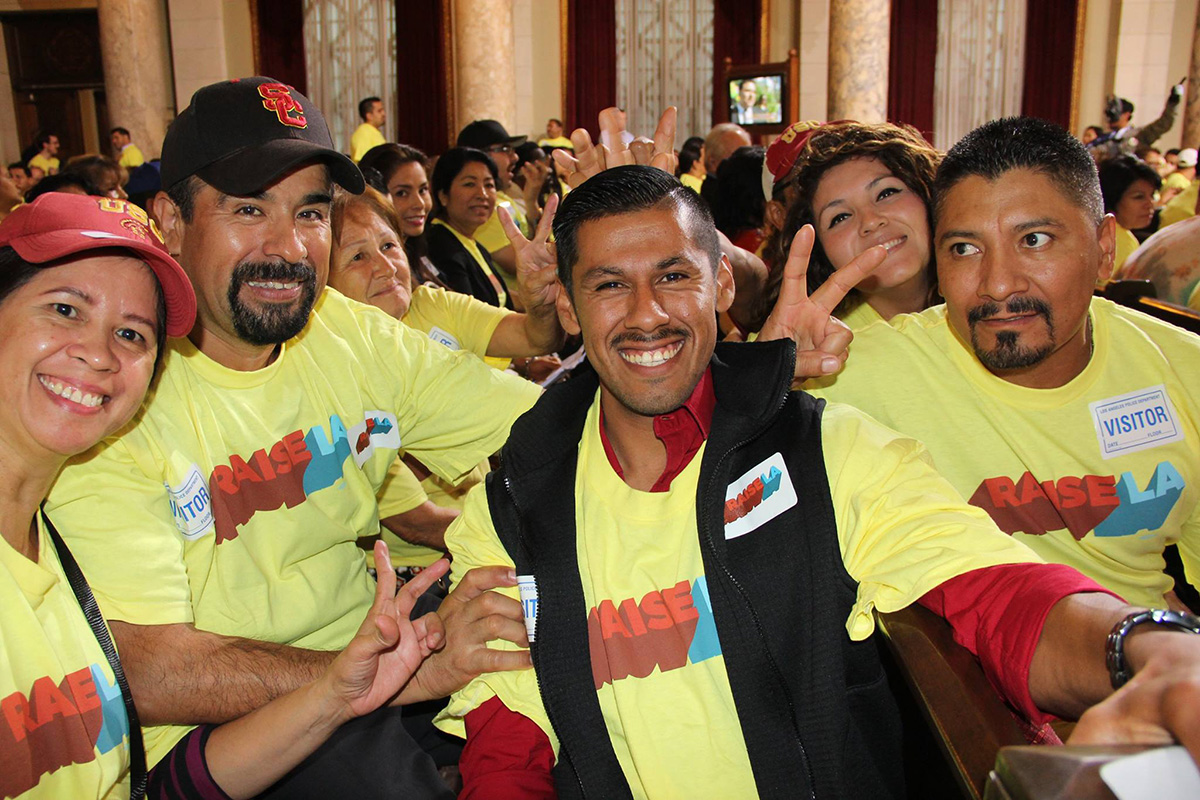
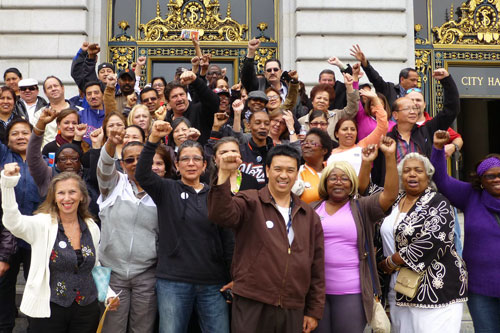
In September 2014, the Los Angeles City Council voted 12-3 in favor of a historic new law creating a $15.37 per hour minimum wage for people working in big hotels in Los Angeles. This is the now one of the highest local minimum wages set in the United States with the potential to change the lives of 15,000 working people and their families.
The measure was backed by the Raise L.A. coalition, made up of hundreds of UNITE HERE Local 11 members, non-union hotel workers, LAANE, the L.A. Federation of Labor, 35 community organizations, churches, and 17 neighborhood councils.
The City Council members who championed the measure noted that, while the hotel industry thrives because of the tourism investments local government approves, the average L.A. hotel worker takes home just $18,000 per year. Under Raise L.A., hotel employees will earn an additional $9,000 per year. This boost will stimulate consumer spending and related economic activity by an estimated $71 million per year, which is why hundreds of small businesses signed on to Raise L.A., too.
Revenue for the industry’s largest hotels are projected to top a record $1 billion in 2014, but evidence shows that staff aren’t seeing that growth in their paychecks. Of the past decade, this year saw the lowest percentage of hotels’ total room revenue going toward worker compensation.
Raise L.A. will affect the approximately 60 hotels in Los Angeles with more than 150 rooms, requiring them to pay all workers a minimum of $15.37 per hour. In addition to boosting wages, the policy will give workers five paid sick days and protect tipped earnings. These benefits apply to all workers in the hotels, whether the workers are there as direct employees or through subcontractors. The measure will be implemented in two phases through July 2016.
UNITE HERE has a strong track record raising standards for working people across Los Angeles. Over the past 15 years, we have gotten more involved in politics, working with City Council to pass living wages at Los Angeles International Airport and then at nearby hotels. Cities across the country have replicated these measures.
Clergy leaders and union casino workers from the Las Vegas Strip and Downtown joined Station Casinos workers in a march through Summerlin to Red Rock Casino Resort to demand that Station Casinos stop treating their employees like second-class workers.
The Hong Kong Confederation of Trade Unions (HKCTU) – the only independent union in China – has called for workers to strike in support of the democracy movement as mass civil disobedience actions come under heavy police attack. The Swire Beverages (Coca-Cola) union and the HKCTU unions of school teachers and dockers are striking and will be joined by other member unions.
Tensions have been building in Hong Kong since the August 31 government announcement that candidates for the position of Chief Executive would have to be vetted and approved by a pro-business, pro-Beijing committee.
The protests, originally organized by the students’ federation and the Occupy Central coalition, have drawn increasing numbers of supporters. The mainland government has harshly condemned the protestors’ demands and the “illegal” protests.
On October 28, the HKCTU declared “we cannot let the students fight alone”, and called for workers to strike in support of 4 demands: the immediate release of all the arrested, an end to the suppression of peaceful assembly, replacing the “fake universal suffrage” formula with the genuine political reform workers have been demanding, and the resignation of Chief Executive Leung Chun Ying.
The HKCTU has been the backbone of the democracy movement, before and following Hong Kong’s return to Chinese rule. Their courageous action deserves the support of trade unions everywhere.
CLICK HERE to send a message to the Hong Kong Chief Executive in support of the democratic movement and the strikers’ demands!
This post by UNITE HERE President D. Taylor was published at Politico Magazine’s “The Agenda,” in a piece titled: Obamacare 2.0: The Affordable Care Act survived Year One. Fifteen health-care thinkers tell us how to fix—or reimagine—it for the long haul:
One year later, the Affordable Care Act (ACA) exchange marketplace has greatly reduced the number of uninsured Americans. That was one of the law’s goals. But, as the leader of a growing union with more than 270,000 members, I do know this: Obamacare needs to be fixed. And, that conversation will, and should, shape the politics of 2016.
Despite unrelenting efforts by Republicans, Obamacare is here to stay. But if Democrats think all is well with the ACA, they should know better. If they truly believe in the benefits of expanded access to health care, they need not only to celebrate those added to the health-care rolls, but also to fix the law to protect those who have lost or will lose their existing coverage due to the law’s perverse incentives.
While the ACA has helped millions of people obtain insurance for the first time, if Washington doesn’t get its act together, millions more will see dramatic reductions in benefits and cost increases in their coverage. The five largest for-profit health insurance companies spent a billion dollars a month buying up other insurers and providers in the two years leading up to enrollment. There isn’t nearly as much competition as we’re going to need.
At the same time, nonprofit health plans sponsored by unions and churches, often the only real competition for the for-profit insurers before reform, don’t have access to the ACA’s subsidies. These plans are having trouble keeping their own members because employers see less comprehensive subsidized exchange coverage as a cheaper option. Nonprofit health plans also cannot offer their services on the ACA exchanges in fair competition with the for-profit sector. Self-funded nonprofit plans are regulated strictly by the federal government—additional licensing and solvency requirements by state regulators can cost $20-$50 million per state. Our plans do not have billions in cash reserves.
The law creates two perverse incentives for employers who currently provide comprehensive health coverage: Dump workers onto the exchanges with the likelihood of less comprehensive coverage or reduce coverage in their existing plans. The temptation for employers to dump covered workers onto the exchanges is enormous given the difference in costs. Our plans typically cover more than 90 percent of workers’ costs in traditional low-wage industries. However, employer-sponsored plans qualify as “affordable” under the ACA if they account for just 60 percent of the patients’ costs. Most people can’t afford 40 percent of their medical costs plus a premium, but new University of South Carolina polling shows that more than 70 percent of Fortune 500 employers are increasing workers’ costs. The overall impact of the law on working class families with good, comprehensive health coverage is a hard push in the direction of less coverage and more out-of-pocket costs.
The ACA has done nothing to address the drivers of escalating health-care costs. Profit-driven hospital systems are building local and regional monopolies unchecked, and pharmaceutical costs continue to soar. These underlying trends are driving insurers to protect their own bottom lines with perverse new tactics like trying to drive high-cost patients, so called “non-preferreds,” out of drug plans.
These challenges are very real and need to be addressed. As 2016 kicks into full gear for president and Congress, including key Senate races, we will be watching the discussion closely. The ACA is potentially a good law, but it needs to be fixed.
After organizing and joining UNITE HERE Local 8, food service workers at Seattle University overwhelmingly ratified their first union contract on September 17.
“I’m so proud we won consistent raises, immigrant rights, and cheaper health insurance for me and my coworkers,” said negotiating committee member Glenda Navas, a cashier at the university for over 6 years. “And—most importantly—job security!”
Workers went to management at the end of the academic year in 2014 with strong majority support for the Union and demanded recognition. Student and faculty supporters joined the delegation, and union members from around the Puget Sound region helped successfully organize at Seattle U.
“As a student at Seattle U, my greatest sources of pride and commitment to our mission of social justice have been moments like these, when staff and students are able to see a direct impact in our communities,” said Lorena Mendoza-Flores ’15.
“We welcome Seattle University workers to our Union,” said Melody Swett, cocktail server and longtime union member at the Westin Seattle. “Together we can raise the standards for food service workers across the city.”
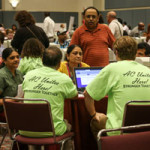
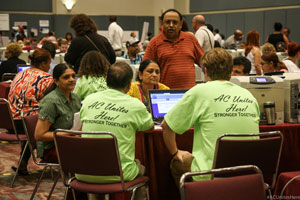
In response to the unprecedented closure of three Atlantic City casinos in less than three weeks, UNITE HERE Local 54 joined state, county, and local government and community partners to run the AC Unites Here resource center September 3–10.
The closures affect about 7,500 workers—from the Showboat, Trump Plaza, and Revel casinos. The center was open to all workers from the closed casinos; only 2,500 of those laid off are UNITE HERE members.
The AC Unites Here resource center featured 18 different partner organizations offering services: assistance applying for unemployment benefits and food stamps, as well as mortgage modifications, utility assistance, and health care. The resource center was the largest event designed to help laid-off casino workers meet their basic needs and get back on their feet.
Over 200 Local 54 members and staff set up 100 computer stations at the Atlantic City Convention Center. An estimated 2,000 people came through the resource center in the first three days, applying for benefits in 9 different languages.
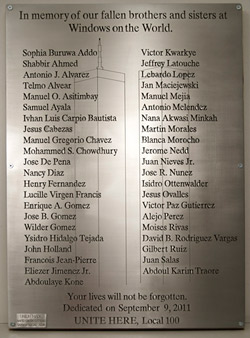
On the 13th anniversary of September 11, 2001, UNITE HERE remembers all those who lost their lives on that tragic day. We hold especially close the memory of our 43 sisters and brothers from UNITE HERE Local 100 who died while working at Windows on the World, a restaurant located at the top of the North Tower of the World Trade Center.
In memory of our fallen brothers and sisters at Windows on the World:
Sophia Buruwa Addo
Shabbir Ahmed
Antonio J. Alvarez
Telmo Alvear
Manuel O. Asitimbay
Samuel Ayala
Ivhan Luis Carpio Bautista
Jesus Cabezas
Manuel Gregorio Chavez
Mohammed S. Chowdhury
Jose De Pena
Nancy Diaz
Henry Fernandez
Lucille Virgen Francis
Enrique A. Gomez
Jose B. Gomez
Wilder Gomez
Ysidro Hidalgo Tejada
John Holland
Francois Jean-Pierre
Eliezer Jimenez Jr.
Abdoulaye Kone
Victor Kwarkye
Jeffrey Latouche
Lebardo Lopez
Jan Maciejewski
Manuel Mejia
Antonio Melendez
Nana Akwasi Minkah
Martin Morales
Blanca Morocho
Jerome Nedd
Juan Nieves Jr.
Jose R. Nunez
Isidro Ottenwalder
Jesus Ovalles
Victor Paz Gutierrez
Alejo Perez
Moises Rivas
David B. Rodriguez Vargas
Gilbert Ruiz
Juan Salas
Abdoul Karim Traore
The families and coworkers of those mostly immigrant workers talk about their loss, their dreams, and their challenges in the movie “Windows.”
Nearly one in four airline catering workers — 24% — say unauthorized people could get into their kitchens and trucks, and the same percentage warned that someone could place contraband on a food cart, according to a survey obtained by USA TODAY.
Unite Here, a union representing 12,000 airline catering workers nationwide, surveyed 400 of its members and provided an 18-page report to the Transportation Security Administration on Monday.
Ending a fight that lasted through three years and a World Series win, workers at the home stadium for the San Francisco Giants baseball team ratified a champion new contract recently. Local 2 members at AT&T Park stayed strong through strikes, civil disobedience, and a worker-called boycott of garlic fries and other concessions and now enjoy what may be the best stadium contract in the United States.
Workers won more comfortable and convenient rest and meal breaks; stronger protections for immigrant workers; seniority scheduling; and caps on workloads for suite attendants. They also won benefit and wage improvements that are tied to a strong hotel contract, including raises for both non-tipped and tipped workers, gratuity percentage increases for suites and catering workers, and pension contributions that will double over the life of the contract. Finally, the new contract also secures successorship with worker retention at the ballpark and automatic hiring at the new San Francisco 49ers football stadium.
After organizing to join UNITE HERE Local 26, food service workers at three Boston-area universities Recently ratified their first union contracts unanimously.
Employed by Chartwells, the one hundred workers serve in the dining halls of Wentworth Institute of Technology, Massachusetts College of Art and Design, and Massachusetts College of Pharmacy—all part of the Colleges of the Fenway collaborative.
The one hundred workers will receive substantial pay increases, lower-cost heath benefits, and numerous other improvements to their working conditions.
Workers went to management at the start of the academic year in 2013 with majority support for the Union and demanded recognition. Colleges of the Fenway cafeterias are next to Northeastern University, whose 400 cafeteria workers joined Local 26 in 2012, and Simmons College, where workers won their contract earlier this year. Workers at nearby Wheelock College are currently negotiating their first contract with Sodexo.
Workers at Simmons first shared the idea of the Union to their sisters and brothers who work at the Colleges of the Fenway. They often take the T together and talk about work. Sometimes, they live in the same neighborhoods.
“We work so hard for our students, but we were really suffering,” said Stella Cosby, a cook at Simmons College. Cosby and her co-workers began reaching out to workers in the area. She said it wasn’t easy , but it helped that the Simmons crew could speak from experience. They’d done it first.
“We knew it couldn’t stop with us,” Cosby added. “We explained that we think we deserve to be treated with respect and dignity and to have better working conditions, and that we could have that through a union.”
Edith “Tiny” Figueroa, a barista at Simmons College, was there when Colleges of the Fenway workers cast ballots to vote in their new contract.
“I really believe that we can raise the standard for food service workers across Boston and Massachusetts. We serve food at some of the nation’s best schools. We deserve better,” she said.
“I’ve been a cook at Wentworth for more than 20 years, “ said Thertilo Blanc. “I’m so glad that we now have a contract that gives consistent wage increases, vacation and sick days, better benefits, and a grievance procedure. We have a voice.”
UNITE HERE Boston’s Local 26 represents 7,000 workers in hotels, campus cafeterias, convention centers, Fenway Park and Logan Airport. Visit their Website at Local26.org.