Did you catch our light show protest on The Truth’s opening night?
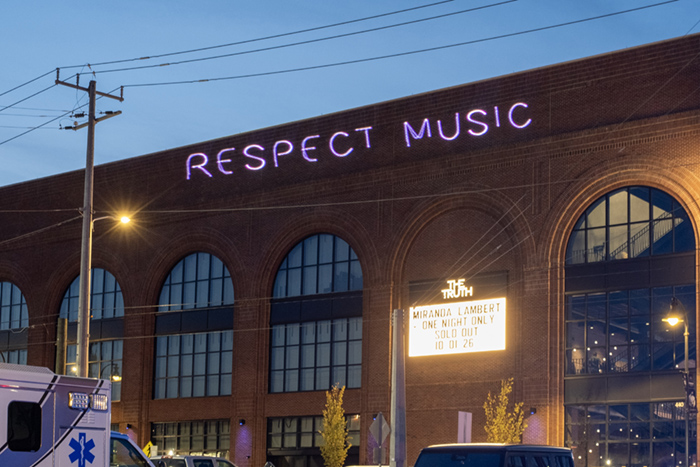

“The Truth” about Live Nation and AJ Capital Partners’ New Music Venue
Since 2020, several longstanding independent music venues in Nashville have closed or transitioned to new corporate ownership, including Exit/In, Mercy Lounge, and High Watt. A study on independent music venues commissioned by the Nashville Metropolitan Council concluded, “as corporate venue players increase their presence, there is fear that independent venues will soon have no place in an increasingly costly city.”
A new corporate venue is opening this year: The Truth. The venue’s website promises “the next chapter in Nashville’s unbeatable music legacy.” If The Truth is right, the next chapter for Music City will be presented not by the independent venues that have always given Nashville its character, but by AJ Capital Partners, a private equity real estate investor with nearly $6 billion of investments worldwide; and Live Nation, which a federal jury found liable for operating as an illegal monopoly in April 2026.
The Truth’s marketing purports to celebrate Nashville’s music community, including artists and concertgoers. But the facts about owners AJ Capital Partners and Live Nation speak for themselves.
Live Nation: “So Casually Cruel”
In 2024, the Department of Justice, joined by 30 state and district attorneys general, sued Live Nation Entertainment, Inc. for monopolization and other “unlawful, anticompetitive conduct” in the live events industry. But on March 9, 2026, one week after the Live Nation trial began, the DOJ unexpectedly announced it had settled with the company, surprising the judge and even some of the lawyers in the trial.
In an intervention that The Wall Street Journal called “bizarre,” the DOJ reportedly settled its lawsuit on direct orders from President Trump. The Journal investigation found that Live Nation CEO Michael Rapino met with Trump in the Oval Office less than a week before the settlement was signed, and the settlement itself was finalized at the White House with then-Attorney General Pam Bondi, rather than at the DOJ. According to the Journal, “Most of the states involved, including those controlled by Republicans, viewed the settlement as so favorable to the company that they refused to join it and continued to trial.”
Tennessee was one of the states that continued the lawsuit. Tennessee Attorney General Jonathan Skrmetti said that Live Nation and its subsidiary Ticketmaster “have ripped off consumers for decades.” On April 15, 2026, a jury found that Live Nation illegally monopolized concert venues and concert ticketing markets. Post-trial proceedings, including possible remedies, are ongoing.
The Senate Permanent Subcommittee on Investigations investigated Live Nation for over a year, and in March 2026 the Subcommittee’s minority staff report concluded that Live Nation, via its subsidiary Ticketmaster, “has used its enormous market power and control over data to make concert-going unaffordable and has misled the public and Congress in doing so,” and, “Under the settlement, Live Nation will still be able to leverage its power over musicians and venues to drive the adoption of price gouging tactics.”
Shortly after the DOJ settlement, the New York Times obtained Slack exchanges between regional ticketing directors at Live Nation saying of customers, “These people are so stupid,” “I almost feel bad taking advantage of them,” and “Robbing them blind baby. That’s how we do.”
Now, AJ Capital is helping to bring a new Live Nation venue to Nashville.
AJ Capital Partners: “They pretend they’re adding to this arts ecosystem, but they want to create a new one.”
Private equity real estate investor Adventurous Journeys (AJ) Capital Partners manages over $5.9 billion of real estate investments in the US and the UK. The company’s website states, “With a mission to humanize hospitality through handcrafted projects made by people for people, AJ delivers spaces that evoke emotional connections and become backdrops for enriching life experiences.” This mission statement would seem to be contradicted by partnering with Live Nation, which Tennessee’s Attorney General says has “ripped off consumers for decades.”
The Truth is part of Wedgewood Village, AJ Capital’s 18-acre mixed use development. AJ Capital says Wedgewood Village is “a destination for fashion, art, music, and entertainment set in warehouse-inspired spaces that reflect the neighborhood’s history.” However, in November 2025, the Nashville Scene published an article titled “Development Threatens to Choke Out Wedgewood-Houston’s Creative Class,” which reported, “The speed and scale with which AJ has pursued its singular vision have frustrated longtime residents who built the area’s cultural selling points,” “Many smaller independent businesses, specifically galleries and recording studios, are struggling to find a new equilibrium with the powerful corporation,” and, “Some people in the area aren’t sure if they can make it there.”
AJ Capital’s development of The Truth follows its 2021 purchase of previously independent music venue Exit/In. The private equity firm outbid the venue’s then-owner, who was backed by a GoFundMe campaign with over 4,000 donors. Exit/In’s sale led the Metropolitan Council to pass a resolution calling for a study of “the potentially devastating effects the loss of our locally-owned, independent music venues would have.”
Despite AJ Capital’s frequent allusions to celebrating communities in its developments, in the instances outlined below, AJ Capital’s relationship with the surrounding community has been more contentious than celebratory.
Palo Alto, CA:
In 2019, AJ Capital evicted tenants in some of the most affordable rental housing in Palo Alto to convert their building into a Graduate Hotel. The city said the conversion would violate the zoning ordinance, but Palo Alto Weekly, citing documents obtained by Public Records Act request, reported that AJ Capital’s attorney “both threatened the city with litigation and negotiated with tenants with the goal of silencing their opposition.” The Graduate Palo Alto eventually opened in January 2023. But in June 2026, Palo Alto Weekly reported that dozens of service workers were suddenly laid off and replaced by temporary workers.
Miami, FL:
In 2021, AJ Capital purchased several properties in Miami’s rapidly gentrifying Little Haiti neighborhood, including an immigrant-owned bakery. On July 25, 2024, the Miami Herald reported on a lawsuit alleging that AJ Capital had conspired with an engineering firm to “weaponize” the city’s inspection process in order to declare the building unsafe to evict the bakery and replace it with a music and entertainment venue. The Herald reports that in one email made public in the lawsuit, “an AJ Capital executive wrote of the bakery, ‘Sounded like there might be a strategy to get them out. Anything I can do to help?’” In another, “a consultant suggested the landlords could ‘control’ an engineering firm to ‘produce the exact report we need’ for a government-mandated 40-year recertification for the bakery site.” The bakery owners and AJ Capital reached a settlement in the lawsuit in March 2026, after three and a half years of court proceedings.
East Lansing, MI:
In April 2024, the city of East Lansing notified AJ Capital that the Graduate East Lansing was in violation of conditions of its site plan & special use permit approval from 2015 regarding traffic obstructions caused by its valet system, as well as the East Lansing Zoning Ordinance regarding the hotel’s failure to screen rooftop mechanical equipment. The Graduate failed to take action on the allegations for two years, missing multiple timelines and deadlines provided by the city. The hotel completed the rooftop screening sometime between March and July 2026, only after the city began legal enforcement action. City Council approved a new parking plan for The Graduate in September 2026, but in material provided to the Council in advance of that vote, city officials said that the valet process still “needs to be improved” since traffic spills into surrounding streets and even blocks the sidewalk.
Bloomington, IN:
In July 2024, Indiana Public Media reported on AJ Capital’s attempts to secure a historic building designation for the Graduate Bloomington. At the time of the report, the hotel was only six years old. According to the report, an AJ Capital representative admitted that the request was at least partially motivated by a desire to secure a liquor license for the hotel. Indiana law establishes that no venue within 200 feet of a church can obtain a liquor license if the church objects, but a loophole allows for liquor licenses in a historic district even over a church’s objection. The report quoted one Historic Preservation Commission member’s reply in a public hearing: “I know you’re here for a historic protection so you can get a liquor license. I think the most kind I can be is to describe that as disingenuous. For you to seek to gain the approval of this organization is offensive. Right? Like…insulting.”